
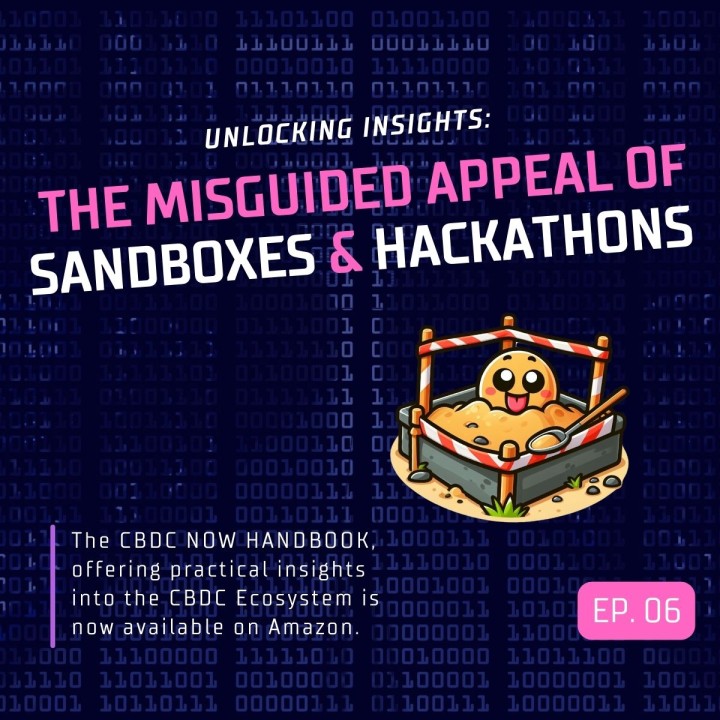
EP6: The Misguided Appeal of Regulatory Sandboxes and Hackathons
In an era where financial technology (FinTech) is evolving at an unprecedented pace, central banks and regulators are at a crossroads on how to foster innovation while ensuring the stability and integrity of the financial system. While regulatory sandboxes and hackathons are often touted as the go-to solutions for bridging the gap between rapid technological advances and regulatory frameworks, a closer examination reveals that these approaches may not be the panacea they are often made out to be. Instead, the path forward requires a more nuanced approach that involves live pilots in controlled, ring-fenced environments to gather real feedback from actual users and businesses using the technologies in question.
Why Regulatory Sandboxes and Hackathons Fall Short
The allure of regulatory sandboxes and hackathons is understandable. They promise a playground for innovation, where fintech firms can experiment with new products and services without the immediate pressure of full regulatory compliance. However, this model has significant drawbacks when applied to the serious business of Central Banking and the deployment of Central Bank Digital Currencies (CBDCs).
Firstly, regulatory sandboxes and hackathons are, by their very nature, artificial environments. They operate in a bubble, isolated from the real-world complexities and dynamics of the financial markets. This isolation can lead to the development of products and services that, while innovative, may not be viable or relevant in the actual market. The feedback and data generated in these controlled settings are limited in scope and depth, lacking the richness of real-world application and interaction.
Moreover, these approaches can inadvertently serve as a stalling mechanism rather than a catalyst for progress. The time and resources invested in setting up and running a sandbox or hackathon could be better utilized in conducting live pilots that test the technology in real market conditions. Such pilots provide invaluable insights into the practical challenges and opportunities of implementing new technologies, far beyond what can be observed in a controlled, experimental setup.

The Case for Live Pilots in Controlled Environments
A live pilot, conducted in a controlled environment, offers a more effective and realistic testing ground for FinTech innovations, especially in the realm of CBDCs. Unlike sandboxes or hackathons, live pilots engage real users—both individuals and businesses—in actual transactions and use cases. This direct engagement with the technology provides a wealth of detailed feedback and data on user experience, system performance, security concerns, and potential regulatory issues in a way that simulated environments cannot replicate.
Live pilots also demonstrate a commitment to progress and practical implementation. They signal to the market, participants, and stakeholders that the central bank is serious about exploring and potentially adopting new technologies. This can build trust and foster a collaborative environment for innovation, where feedback from real users and businesses is actively sought and incorporated into the development process.
Conclusion: Moving Beyond the Sandbox
While regulatory sandboxes and hackathons may have a role in the broader ecosystem of innovation, they should not be the primary avenue for central banks serious about adopting, integrating and deploying new financial technologies like CBDCs. The unique requirements and impacts of such technologies demand a more grounded approach, one that prioritizes real-world testing and feedback over theoretical experimentation.
Live pilots in controlled environments offer a more viable path forward. They provide actionable insights, foster genuine innovation, and ensure that the development of financial technologies remains aligned with the needs and realities of the market. As central banks navigate the challenges of the digital age, it is imperative that they adopt strategies that move beyond the sandbox, embracing real-world testing to truly drive progress and innovation in the financial sector.
Further Learning on CBDC
For those eager to explore more about Central Bank Digital Currencies (CBDCs) and the evolving landscape of central banking, the Chavanette Website, as well as our Alpha Knowledge Platform (αLP) serve as an invaluable resource. Furthermore, there is our CBDC Handbook & Encyclopedia, designed to offer comprehensive insights into this emerging field.
Join the Discussion
We invite you to engage in a discussion on the pivotal role of live CBDC pilots. Do you think hackathons or sandboxes serve a greater purpose than how we portrayed them?
Contact us to learn more about Chavanette Advisors’ approach to setting-up, running and scaling-up a live CBDC pilot for you.